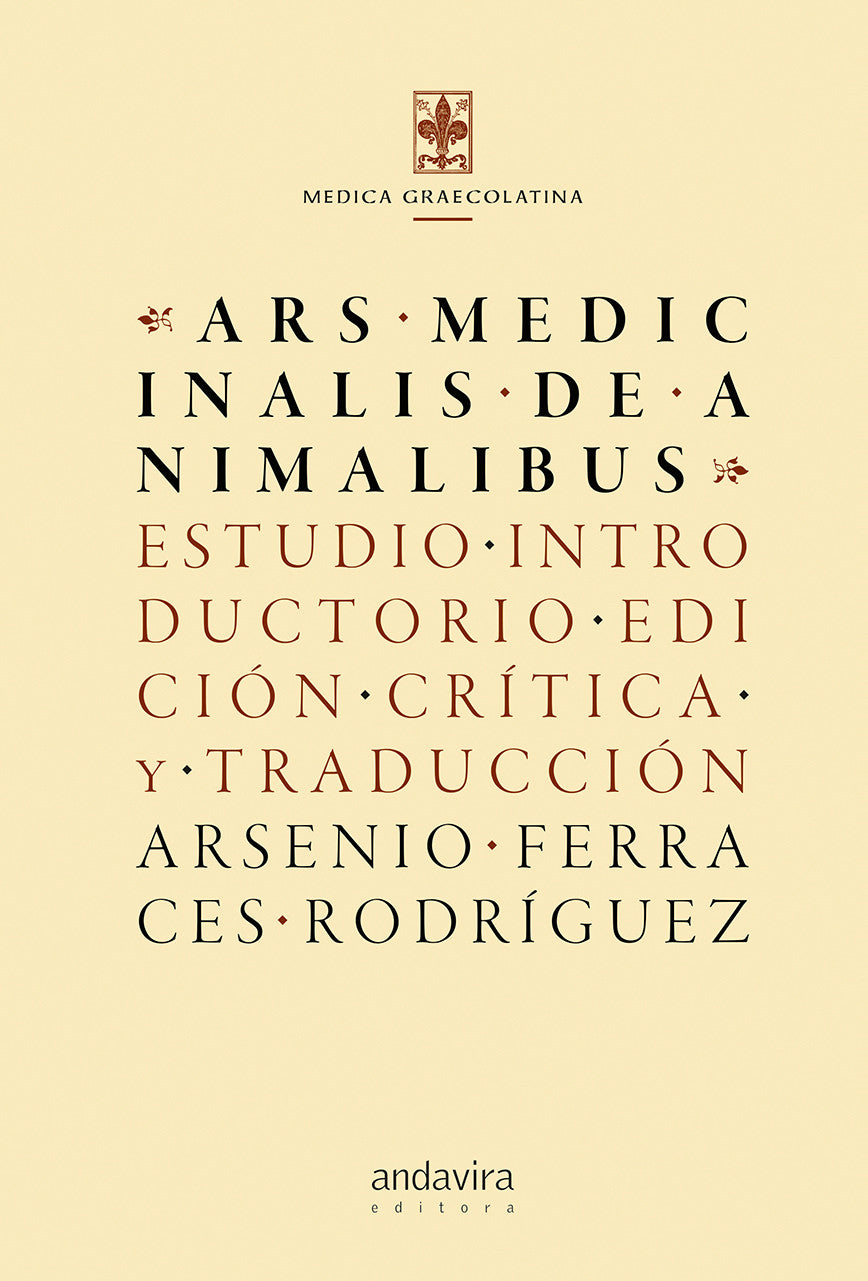
Arsenio Ferraces Rodríguez
The Medicinal Art of Animals
The Medicinal Art of Animals
Couldn't load pickup availability
Share
TABLE OF CONTENTS
Prologue, justification, and retraction.
I. INTRODUCTORY STUDY
1. Ars medicinalis de animalibus: the text and its transmission.
1.1. A bestiary and its manuscript tradition.
1.2. Two redactions of the same bestiary.
1.3. Medical recipe book in books: organization of content, book titles, and work title.
2. Sources.
2.1. The Ars medicinalis de animalibus and the Liber medicinae ex animalibus of Sextus Placitus Papyriensis: an overview.
2.2. Regarding quadrupeds: a major source - Sextus Placitus Papyriensis - and an unidentified secondary source.
2.3. Another main source from the chapter Nomem aseno?
3. The chapter on the goat: data for the study of the Ars medicinalis de animalibus and for the affiliation of the Sextus Placitus manuscript used by the author.
3.1. The problems of the recipe Ad prodiginem uel ad uipere morsum.
3.2. The recipe Ad aurium dolorum.
3.2.1. Two accidents of transmission: the transposition of the title ad oculos albugines and the reading pueris uirgines.
3.2.2. The corruption of omnium (= de homine) and the placement of the fragment in the manuscript tradition of Sextus Placitus Papyriensis.
3.3. The title De homine.
3.3.1. A matter of relative chronology: in the source, the title De homine preceded the title De puero et uirgine.
3.3.2. New light on the chapter titles in the original redaction of the Ars medicinalis de animalibus.
4. Archeology of the Ars medicinalis de animalibus.
4.1. The two redactions descend from a common earlier model.
4.2. Addition or suppression of chapters?
4.3. Selection of chapters from the Ars medicinalis de animalibus in an earlier model common to the Harleian and Vindobonensis manuscripts.
4.4. Intermediate transmission phases.
4.5. An archetype with recipe titles in the margin.
5. Two extracts in a 12th-century manuscript.
5.1. Two passages from the Harleian-Vindobonensis version (Anim. harl.-vind. 2, 5, 4; 2, 8, 1).
5.2. Possible origin in a lost manuscript of the Harleian-Vindobonensis version.
6. Period of redaction.
7. The critical edition and translation of the text.
7.1. Editorial criteria in the Sangallensis version.
7.2. Editorial criteria in the Harleian-Vindobonensis version.
7.3. A note on the translation.
Bibliography.
II. CRITICAL EDITION AND TRANSLATION.
1. Liber bestiarum /
2. Super volatilibus artis medicina
Appendix 1: Transcription and minimal correction of the text from the Vienna manuscript, ÖNB, 187.
Appendix 2: Vulgar Latin and wordplay in the interpolation pedis et capis (Anim. sang. 1, 9, 1).
III. INDEX TITULORUM MORBORUM
IIII. INDEX VERBORUM MEMORABILIUM