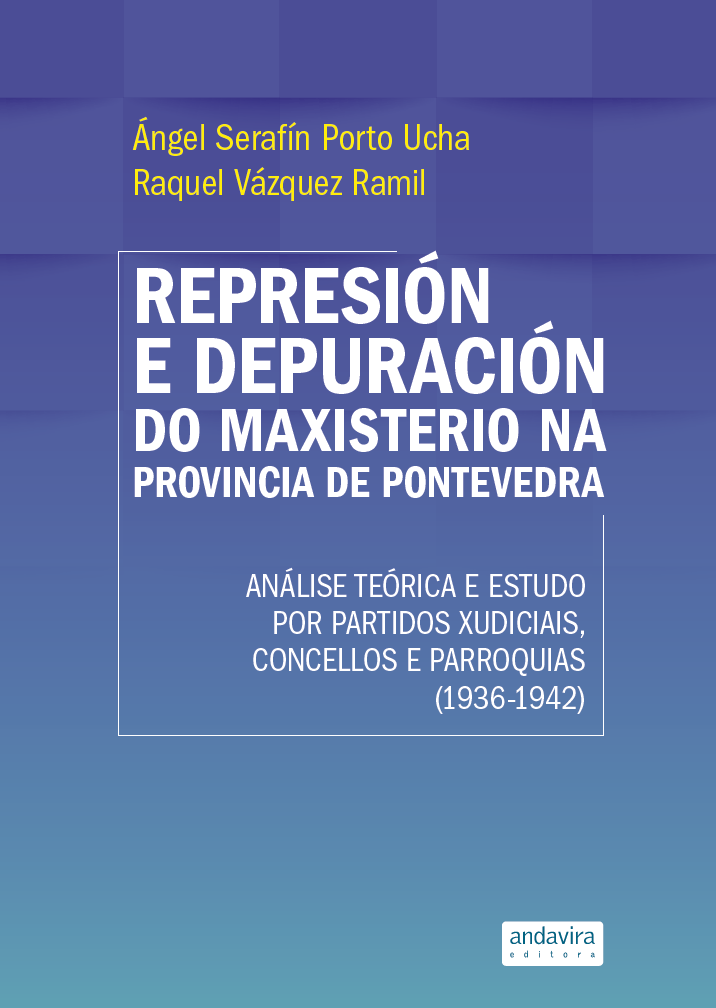
Ángel Serafín Porto Ucha e Raquel Vázquez Ramil
REPRESSION AND PURGING IN THE TEACHING PROFESSION IN THE PROVINCE (1936-1942) OF PONTEVEDRA.
REPRESSION AND PURGING IN THE TEACHING PROFESSION IN THE PROVINCE (1936-1942) OF PONTEVEDRA.
Couldn't load pickup availability
Share
In this book about the purging of teachers in the province of Pontevedra, we study a process that affected almost all teachers, with some exceptions who remained outside of it. The professionals most identified with the republican socio-educational initiatives were those who received the most severe punishments.
Many teaching professionals who survived the tragedy of the civil war or the uncivil war had no other option than to immerse themselves in a particular and harsh internal exile, from which Franco's regime largely benefited.
The objectives of this work are:
• To analyze the characteristics of two opposing
and antagonistic educational systems: the republican school versus the Francoist school.
• To delve into aspects of educational policy, reforms, and innovations
during the republican period, which help to describe, understand, and explain the subsequent process of purging and repression of teachers.
• To describe the processes of purging and repression through quantitative
and qualitative analysis of all those involved. Approximately one thousand eight hundred primary school teachers from the province of Pontevedra passed through the Provincial Purging Commission.
• To decipher the different phases of the purging of teachers, which sometimes
tend to be confused.
• To record the different sanctions imposed, which are detailed very thoroughly,
both in the main body of the work and in the final appendix, following an alphabetical order.
• To compile the list of all male and female teachers in the province of
Pontevedra subjected to the purging process. Approximately a quarter of those who underwent the purging were sanctioned.
• To collect information on the teachers who were killed (shot, executed,
etc.), numbering around thirty.
Our intention is to contribute to the recovery of the historical memory of Pontevedra's teachers during the war and post-war years. Those affected were not only the teachers themselves but also their families, friends, and their broader relationships. It is important to give a name and place in History to all of them, not always to the same ones, as is often done for various reasons. In this book, we share Ortega's premise: "The past will not tell us what we should do, but what we should avoid."